



24/7 Car Recovery in Solihull and the M42 Corridor
Car recovery in Solihull is available 24 hours a day for breakdowns, accidents and vehicles that cannot safely continue their journey. Our standard dispatch target is 30–45 minutes across most of Solihull, with an arrival estimate confirmed from the exact pickup point before the recovery vehicle sets off. Coverage includes Solihull town centre, Shirley, Olton, Monkspath, Knowle and Dorridge, together with the M42 corridor and routes towards Birmingham Airport and the NEC.
We recover vehicles from residential streets, business parks, station approaches, car parks and busy main roads. Typical callouts involve flat batteries, alternator faults, failed clutches, gearbox problems, overheating, punctures, misfuelling and accident damage. If a roadside repair is safe and practical, the first objective is to get the vehicle moving. If it is not, we load it securely and transport it to a garage, home address or another agreed destination.
Breakdown Recovery on Solihull's Main Roads
Solihull's road network creates several different recovery environments. The A41 Warwick Road and Solihull Bypass connect the town towards M42 Junction 5, while the A34 Stratford Road runs through Shirley towards M42 Junction 4. The A45 Coventry Road serves Birmingham Airport and the NEC around Junction 6, and Lode Lane carries substantial local traffic between the town centre and the northern side of Solihull. These corridors require a different approach from a quiet breakdown in Knowle or Dorridge.
For an M42 breakdown, move left and reach a place of safety whenever the vehicle remains driveable. Once the precise carriageway, direction and junction are confirmed, the correct recovery unit is dispatched. On ordinary roads such as Warwick Road, Streetsbrook Road or Lode Lane, we assess whether a jump-start, wheel change or minor roadside intervention resolves the problem before arranging a tow.
EV, Hybrid, Low-Clearance and Specialist Vehicle Recovery
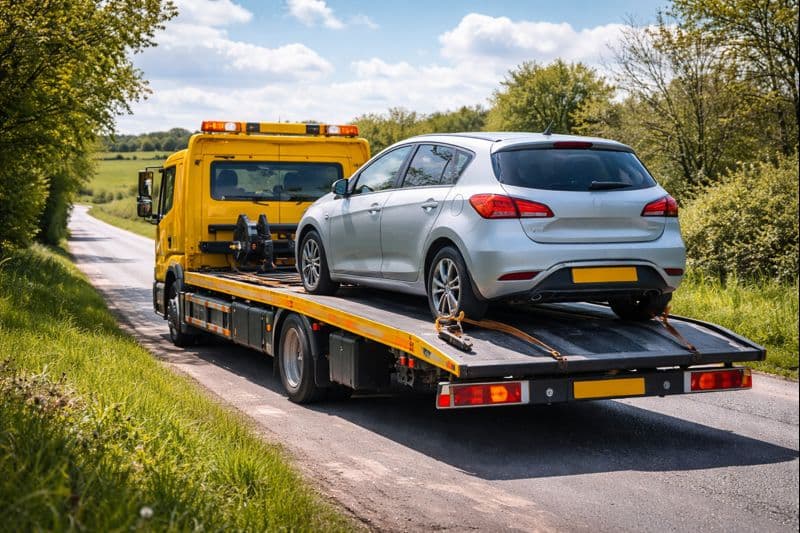
EVs, hybrids and low-clearance cars need equipment selected around the drivetrain, ride height and wheel condition. A flatbed transporter keeps an electric or all-wheel-drive vehicle clear of the road during transport, while low-angle loading reduces the risk of contact with splitters, sills and undertrays. Winches provide controlled loading for non-runners, and wheel dollies move vehicles with locked wheels without dragging the tyres or drivetrain.
The same planning applies to classics, motorcycles, vans and accident-damaged vehicles. A loaded commercial van requires its weight and dimensions checked before dispatch. HGV requests are capacity-checked so a suitably rated heavy recovery unit is assigned rather than a standard car transporter. Locked-key situations are assessed for safe roadside access; when non-destructive unlocking is not suitable, the vehicle can be recovered instead.
From a Solihull Callout to a Safe Destination
Every Solihull recovery starts with four details: your exact location, vehicle type, vehicle condition and required destination. These determine the truck, loading method and quotation. Pricing is based on factors such as recovery distance, vehicle size, accessibility, wheel condition, specialist equipment and the timing of the job rather than an invented one-price-fits-all figure.
That process works whether a battery has failed near Touchwood, a car has stopped close to Solihull Station, a low sports car requires transport from Dorridge, or a vehicle has become immobile around M42 Junction 5. You receive the recovery plan before dispatch, the vehicle is secured using the correct equipment, and it is relocated to the agreed safe destination.
Need car recovery in Solihull now? Call for 24/7 dispatch and provide your location, registration, vehicle type and fault so the correct recovery vehicle can be sent.